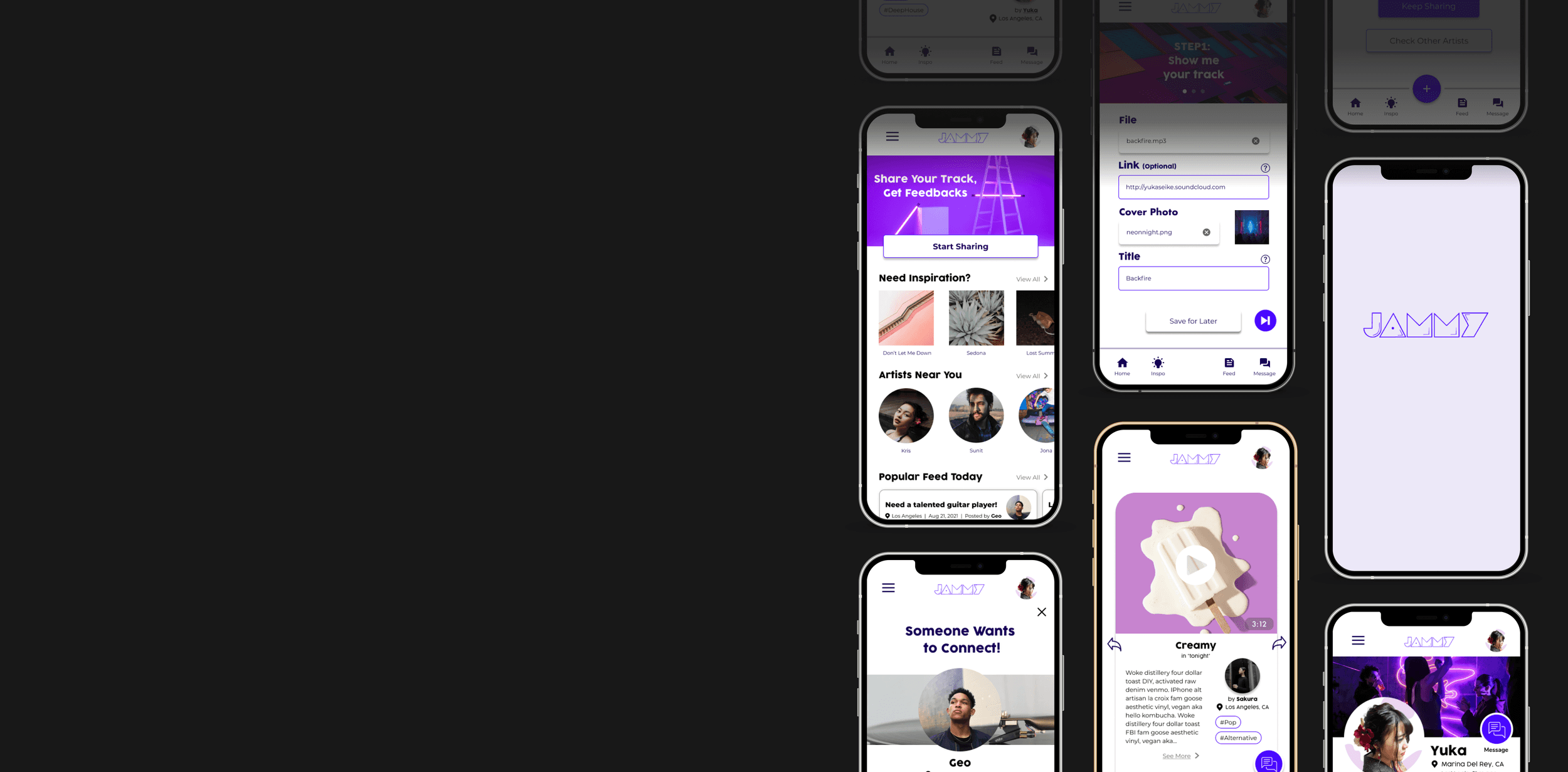

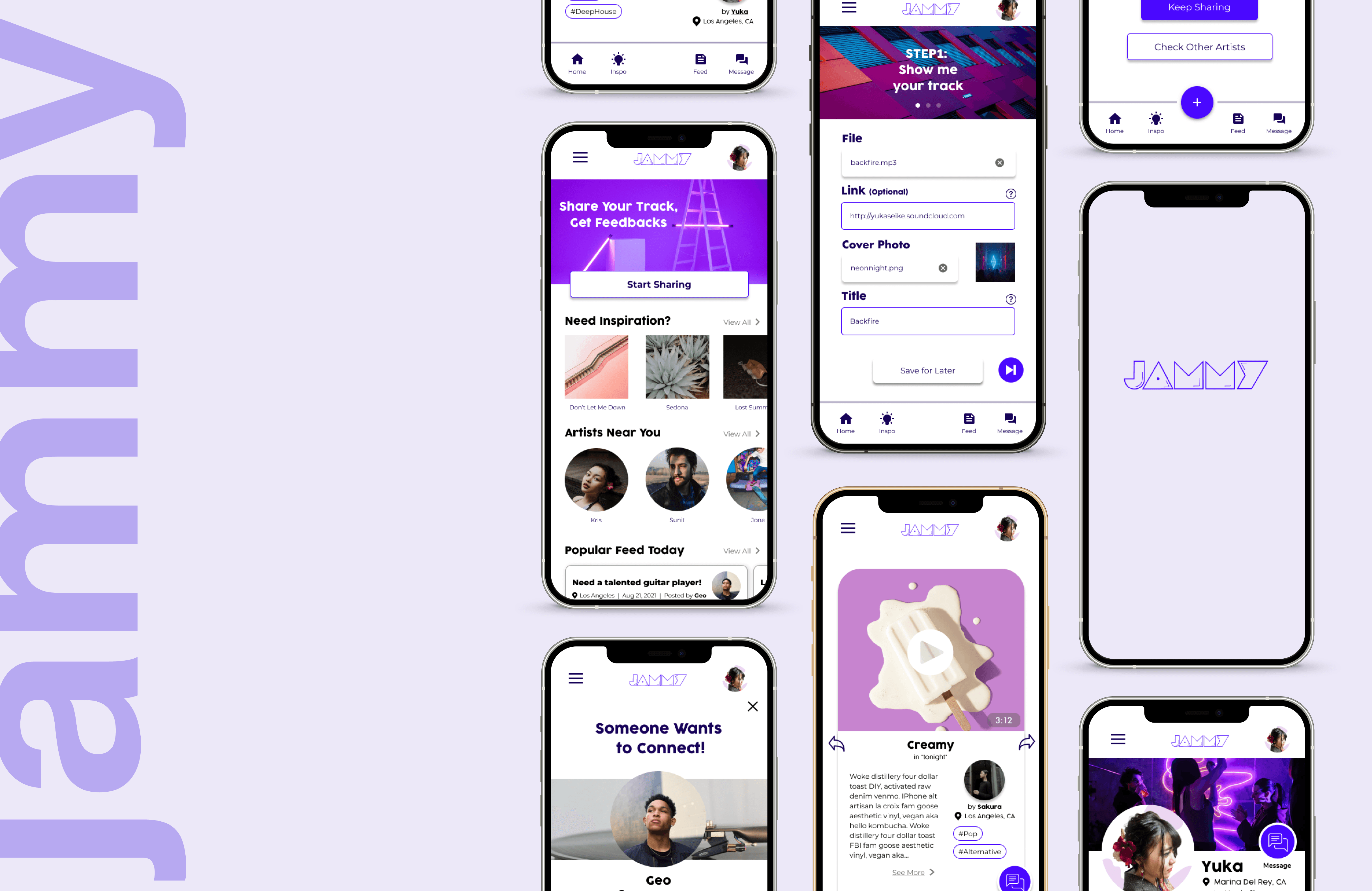
Overview
Between 40-hour work weeks and daily responsibilities, musicians have maybe 8-10 hours weekly to create. But platforms like SoundCloud require complex uploads, and posting to Instagram reaches no one in your local music scene. Of the 6 musicians I interviewed, all had tracks sitting unshared on their computers—not from lack of confidence, but from lack of time and community.
I designed Jammy to cut posting to under 60 seconds and connect musicians within their local area. No global competition. Just collaboration.
Project Type
UX Design | Music Social Platform
TIMELINE
2 months (June - July 2021)
My Role
UX Designer | Researcher
Key Stakeholder
Aspiring and professional musicians
Project context
Google UX Design Certificate Program
Problem
Musicians face a time problem. Between day jobs, studies, and life, creative time shrinks to roughly 8-10 hours per week. When I interviewed 6 local musicians (3 students, 2 working professionals, 1 retired hobbyist), all reported the same pattern: they create music but rarely share it.
The reasons weren't about confidence. They were about friction:
SoundCloud's upload process takes 8+ steps and requires metadata most people don't track
Instagram reaches the wrong audience (friends and family, not fellow musicians)
Existing music platforms are global, making it impossible to connect with the guitarist two blocks away
One quote captured it perfectly:

I have fun making music, I would say it really enlightens my day, my week, my life. But to be honest, it can make me feel very lonely, you know, that I can't share this joy with others.
— Nick, Social Worker in DTLA
When 5 out of 6 musicians abandon their sharing attempts due to complexity or lack of local community, the problem isn't motivation. It's the tools.
Design Challenge
How do we make music sharing simple enough that busy musicians actually do it—and meaningful enough that they keep doing it?

✦ . ⁺ . ✦ . ⁺ . ✦
Research: Why Makes Sharing Hard?
What I learned
Through interviews, surveys, and empathy mapping with 6 musicians, four pain points emerged:
1. Time Constraints
Working adults and students can't afford 10-minute upload processes. Every extra step drops completion rates.
2. Navigation Complexity
Users abandon services when flows are convoluted. SoundCloud's 8-step process with metadata requirements felt like homework.
3. Privacy Concerns
Musicians were hesitant to share personal information (appearance, gender, location) on global platforms where they felt exposed.
4. Self-Doubt & Isolation
Imposter syndrome prevents sharing. Without a supportive local community, musicians second-guess whether their work is "good enough."
Persona
I created Emma Tsai based on interview patterns to keep user needs centered throughout design decisions.

Emma Tsai - Accountant, 27
Busy professional aspiring to freelance as a musician
Moderately tech-savvy, empathetic, extroverted
Goals: Connect with local musicians and share music effortlessly
Challenges: Limited time, self-doubt, lack of community
Problem Statement
Emma is a busy working adult who needs an easy music-sharing service because she doesn't have time for complicated processes. She gives up when platforms are too complex.
User story
"As a busy working adult, I want an easy music-sharing process so I can make it a habit to share my songs and receive feedback regularly."
User Journey Map
I mapped Emma's journey from deciding to share a track through posting and waiting for feedback. Key insights:
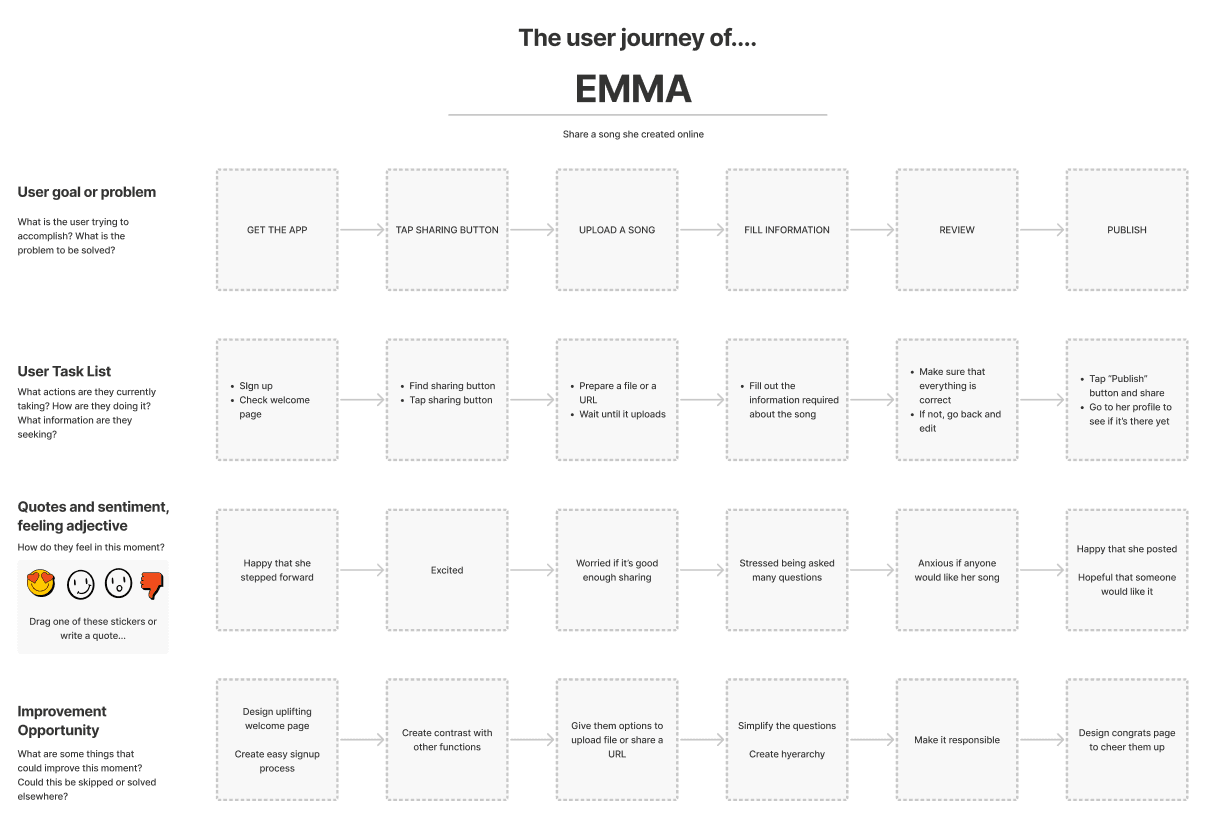
Overview of Jammy’s user journey map
Stressed by too many questions during posting
Worried if work is "good enough" to share
Anxious if anyone would engage with her music
Simplify posting to essential questions only
Design encouraging welcome screens
Create clear visual hierarchy
Some of the interesting insights I extracted from user journey map (pink: feelings, blue: opportunities)
Competitive Analysis
I analyzed SoundCloud, Music Link, and Vampr. While they excelled in specific areas (SoundCloud for discovery, Vampr for networking), none seamlessly integrated music sharing with location-based community building. This gap in the market presented an exciting opportunity to create something truly unique.
✦ . ⁺ . ✦ . ⁺ . ✦
Early Exploration
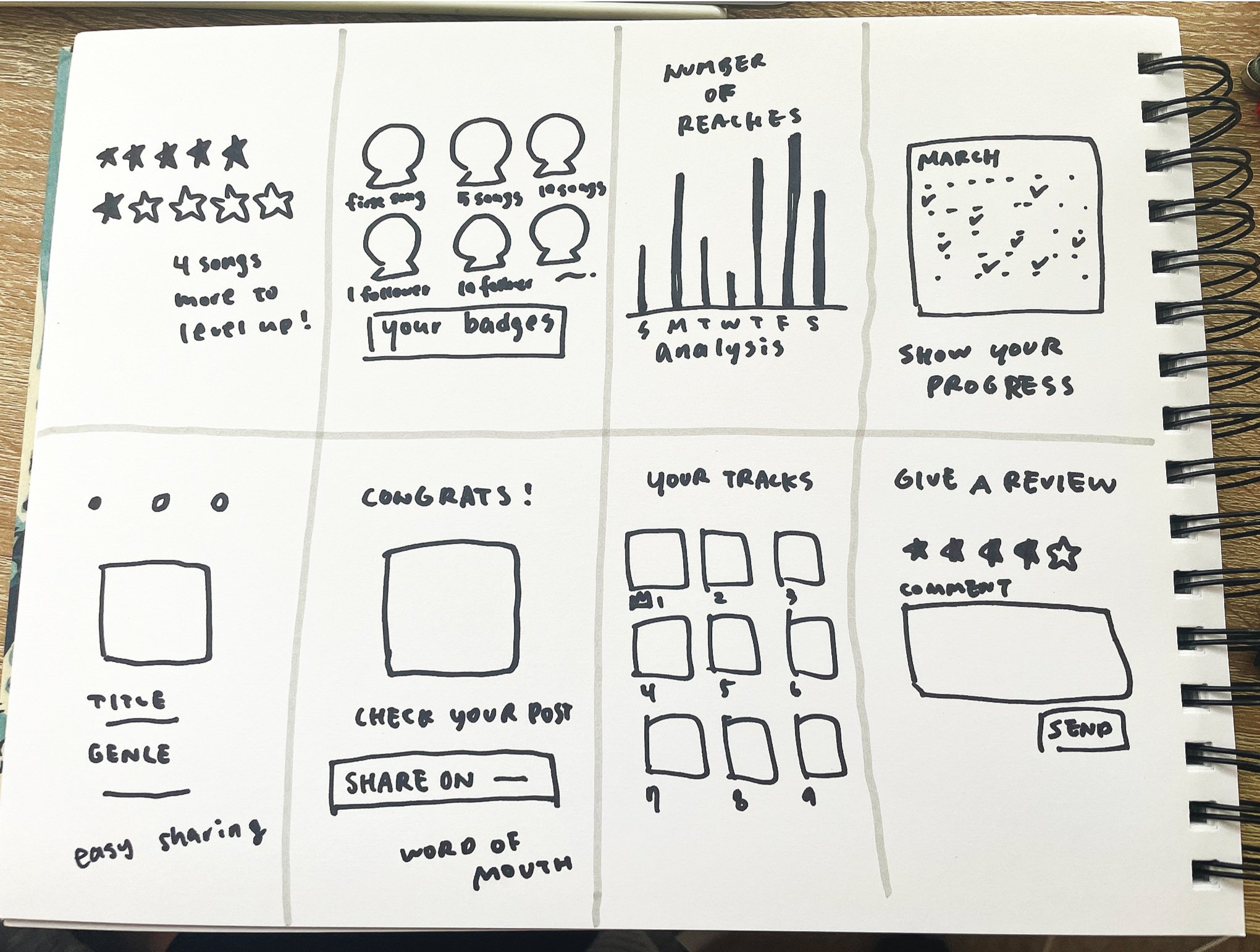
Crazy Eight Exercise
I used rapid ideation (8 ideas in 8 minutes) to generate concepts. While only one directly influenced the final flow, the exercise sparked ideas about gamifying sharing, automating uploads, and reducing friction.
How Might We? Exercise
Using the problem statement I created for one of my personas, Emma, I reframed the statement into questions that will help me come up with ideas to solve the problem.
How might we make music sharing feel like playing a game?
How might we make the posting process take under 60 seconds?
How might we help users discover local musicians effortlessly?
How might we reduce the anxiety of sharing work publicly?
Storyboards
I designed two types of storyboard to demonstrate how users would interact with Jammy. In both, a user uses Jammy to quickly and easily share their music to other musicians for connection.
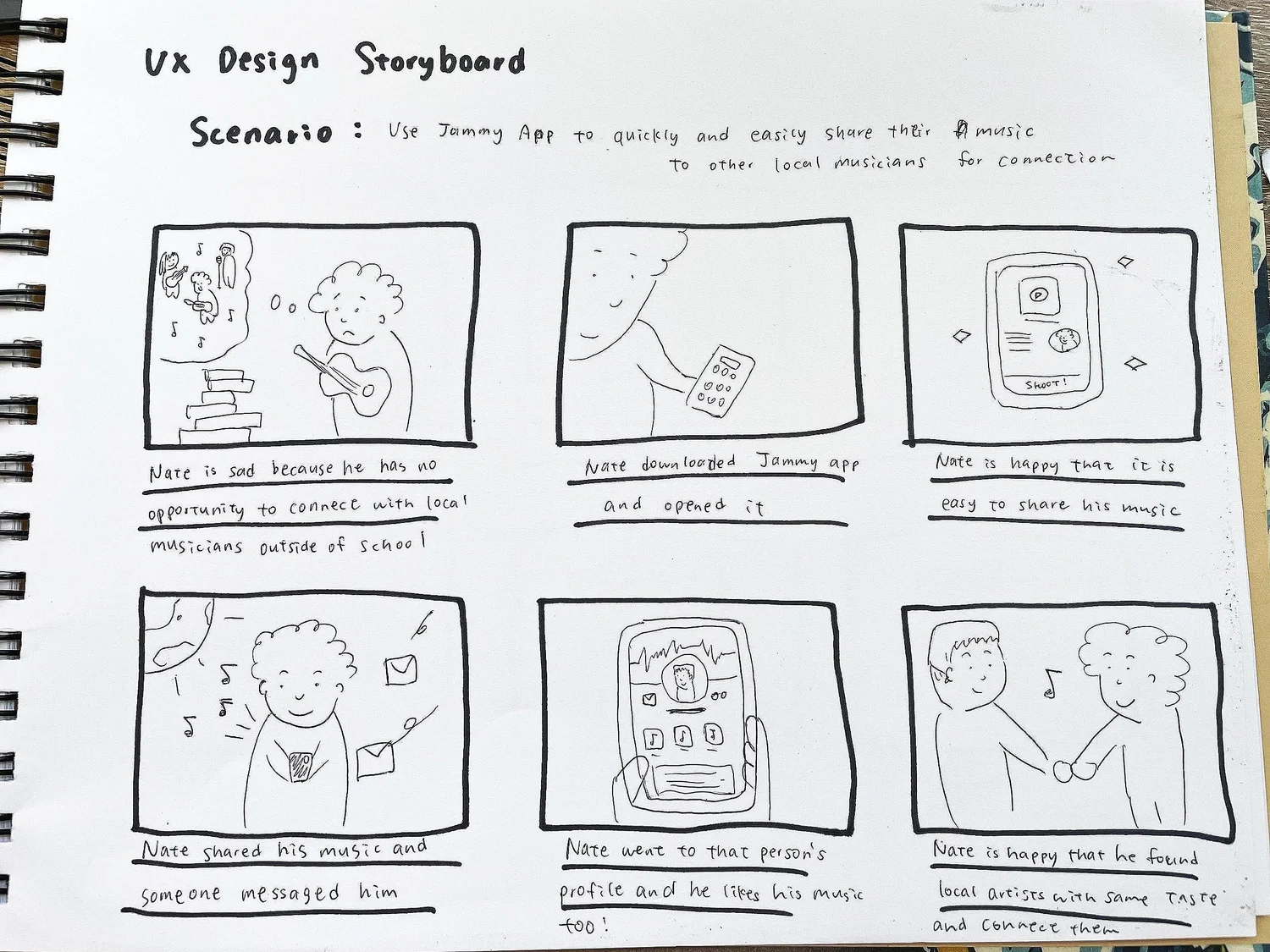
Big Picture Storyboard
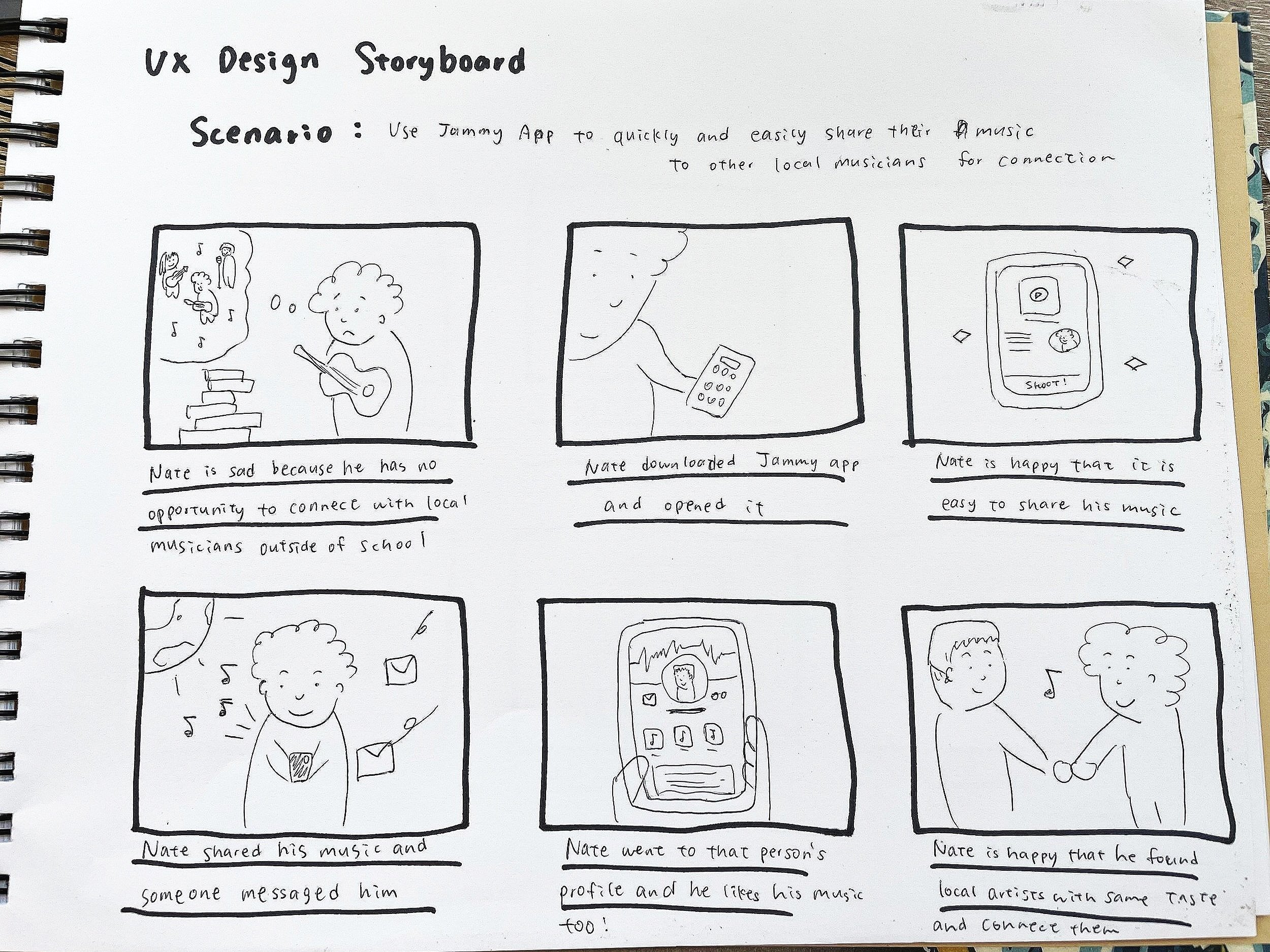
Close-Up Storyboard
Low-Fidelity Wireframes & Prototype
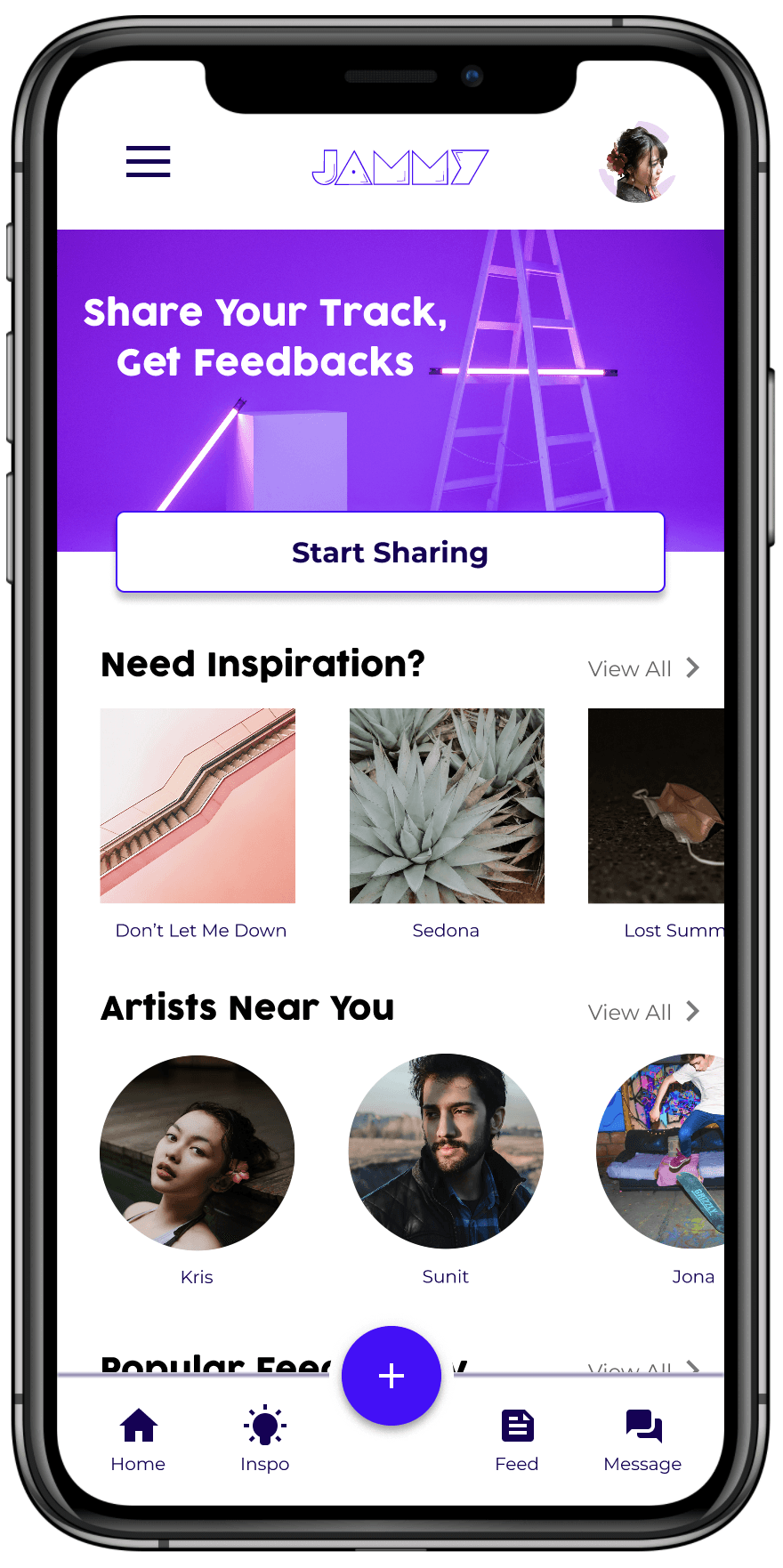
I mapped out some of the main user flows and made lo-fi wireframes to test out. For the home screen, I focused on creating a design that invites users to share their music, aligning with the app's primary purpose. Additionally, users can effortlessly discover other musicians' work for inspiration and potential connections.
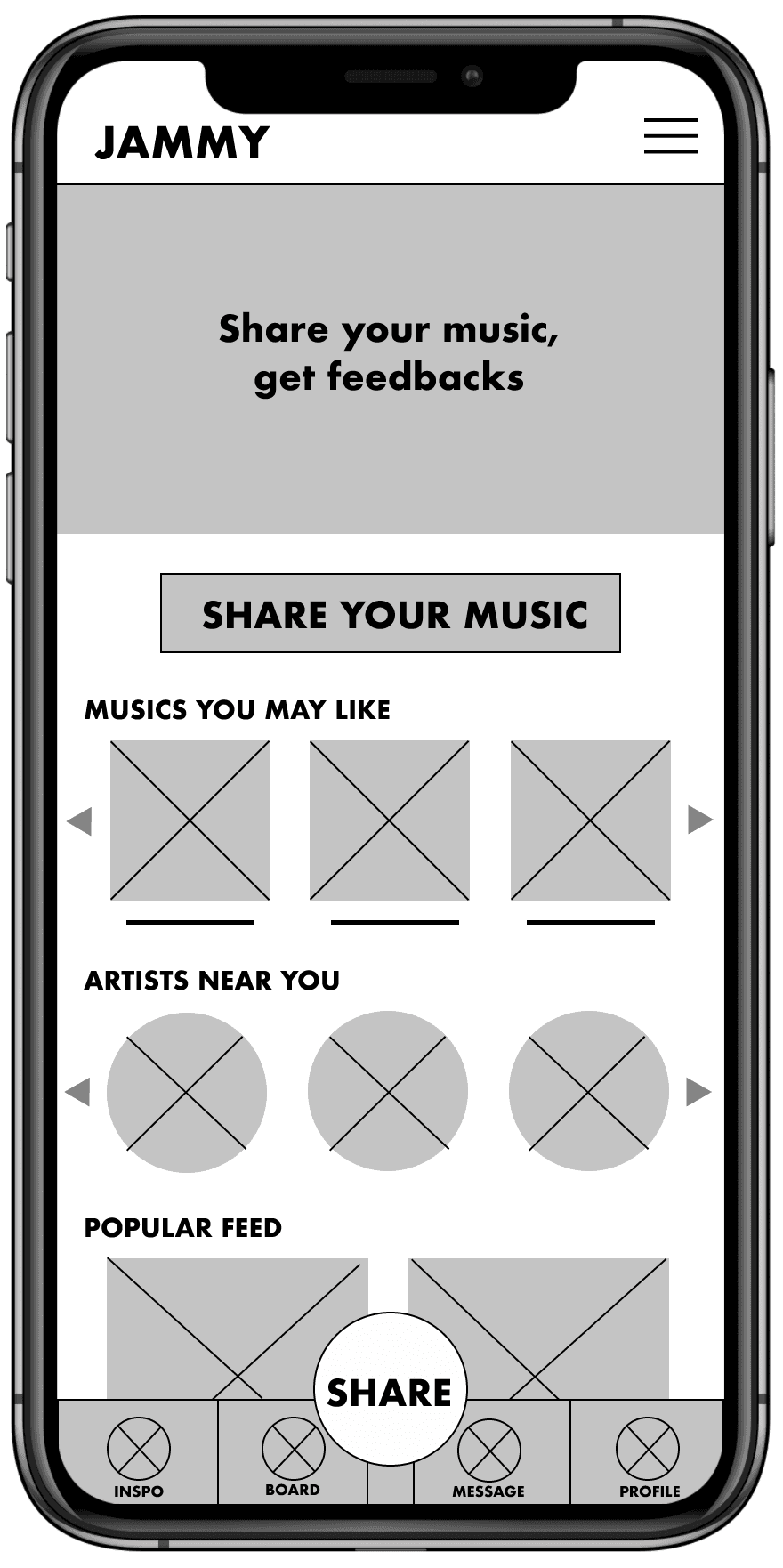
Home Screen
Two prominent sharing buttons to make posting the primary action, with discovery features below.
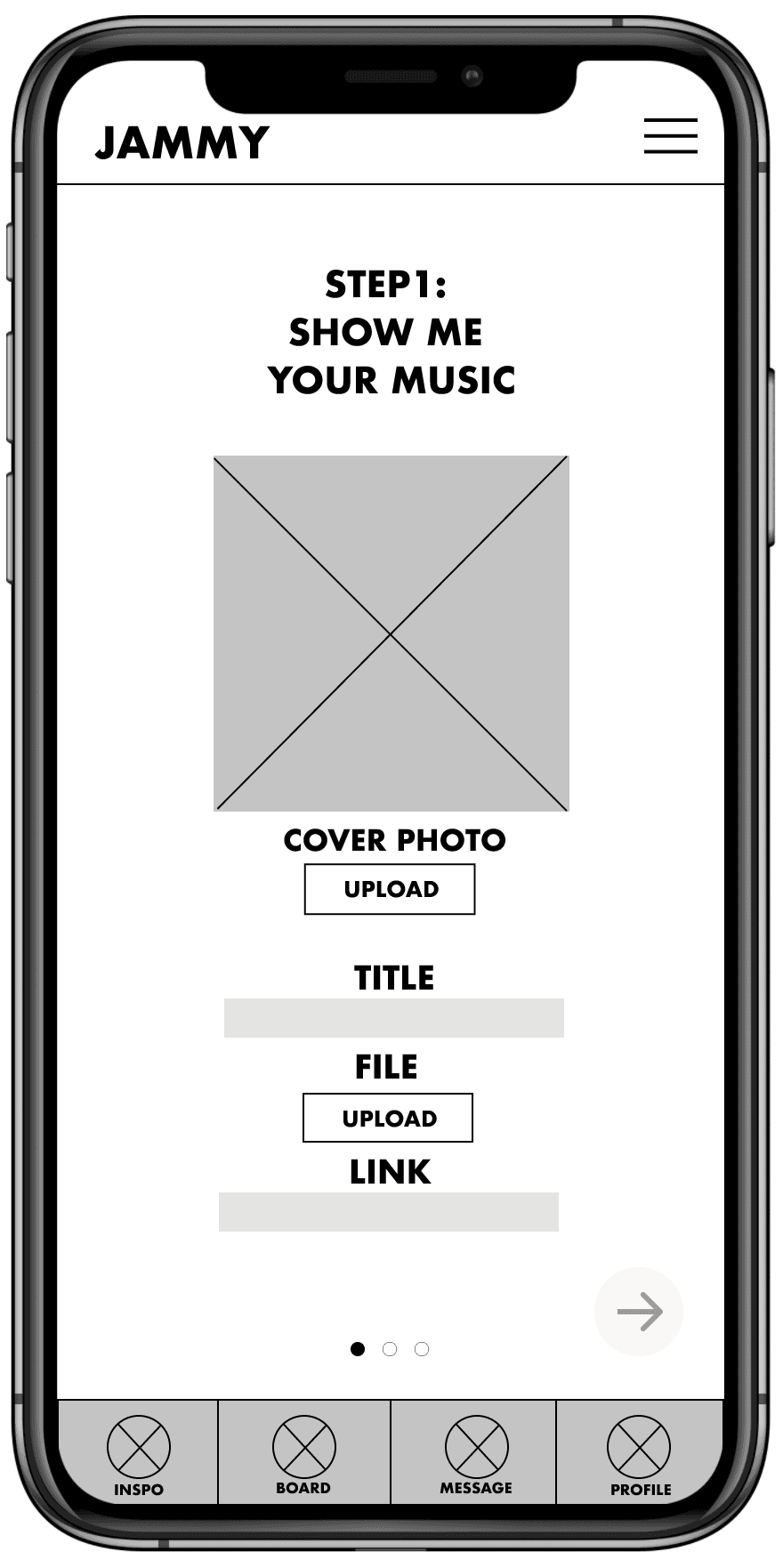
Posting Flow
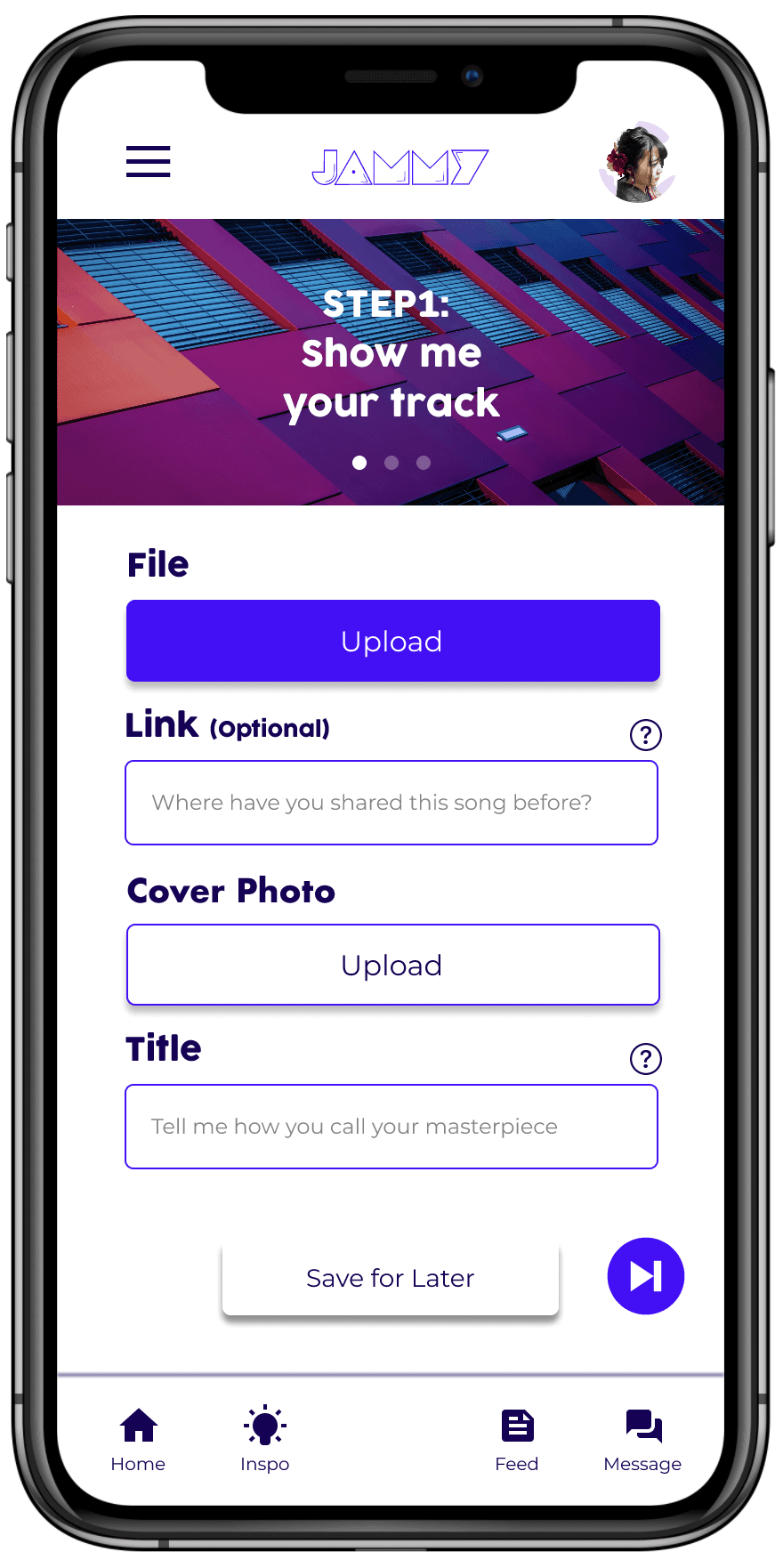
A 3-step process requiring only essential information (track file, title, optional description).
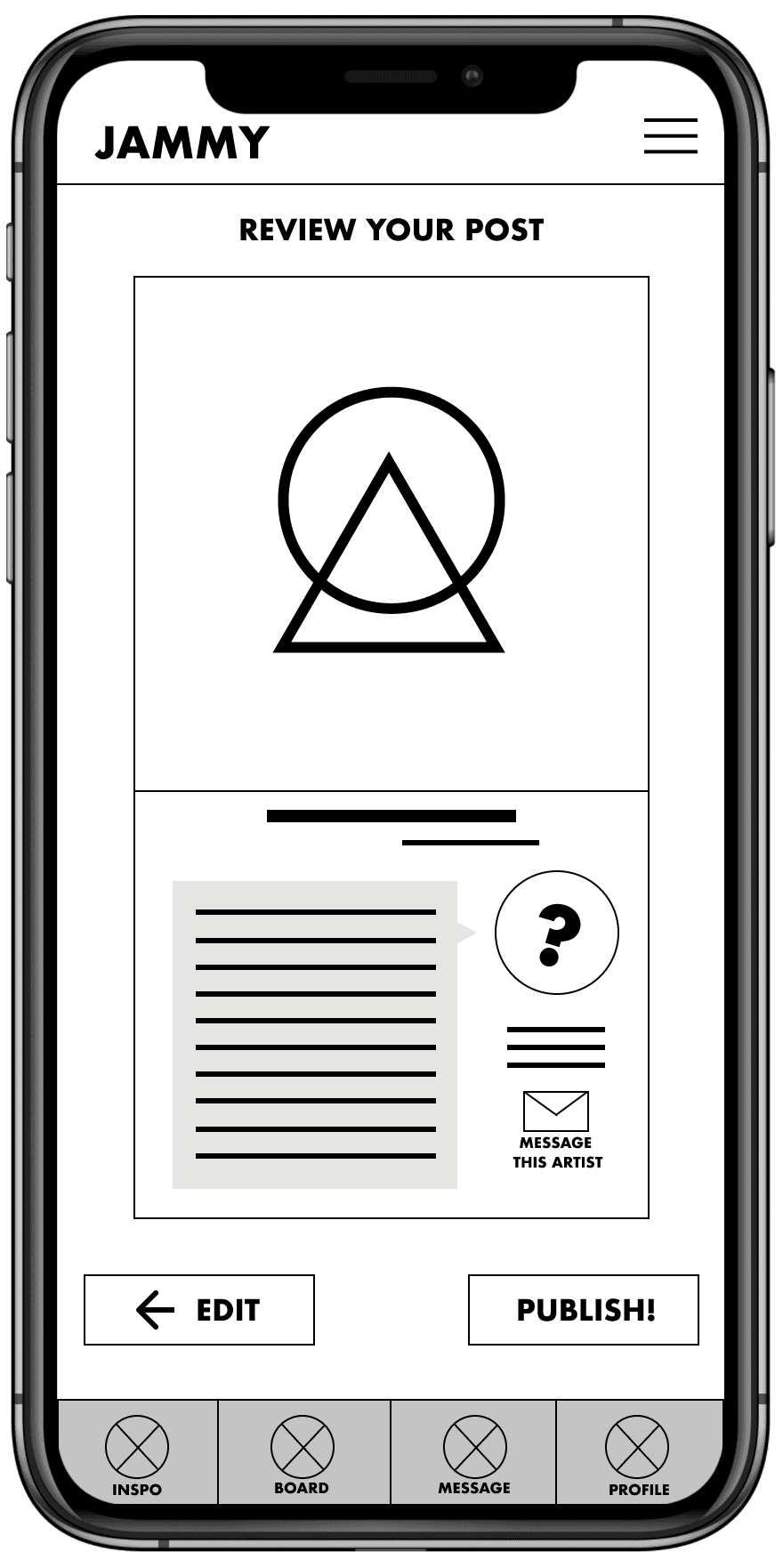
Review Screen
Preview exactly how posts appear to others before publishing.
Try Our Testing Prototype
✦ . ⁺ . ✦ . ⁺ . ✦
Usability Testing
I conducted two rounds of moderated usability testing with 5 participants each round. The first round focused on the home screen, while the second round tested the posting flow.
Round 1: Home Screen
Problems to solve
Font sizes and button targets were too small (below 44pt minimum)
Layout felt cluttered with too many elements competing for attention
Top navigation bar felt cramped on certain screen sizes
How I fixed it
Increased all font sizes by 2pt and buttons to 48x48pt minimum
Simplified bottom navigation from 5 icons to 4, adding a prominent "+" button for posting
Expanded top navigation bar spacing by 8pt

Result:
Task completion improved from 60% to 85%
Round 2: Posting Flow
Step 1
Problems to solve
Text areas and buttons were too small and closely spaced
Users didn't understand what "link" meant (streaming link? social media?)
Cover photo took unnecessary space above the fold
How I fixed it
Enlarged all interactive elements to minimum 44pt touch targets
Added tooltip ("?") button explaining that "link" refers to Spotify/SoundCloud URLs
Reduced cover photo size by 40% to prioritize form fields
Step 2
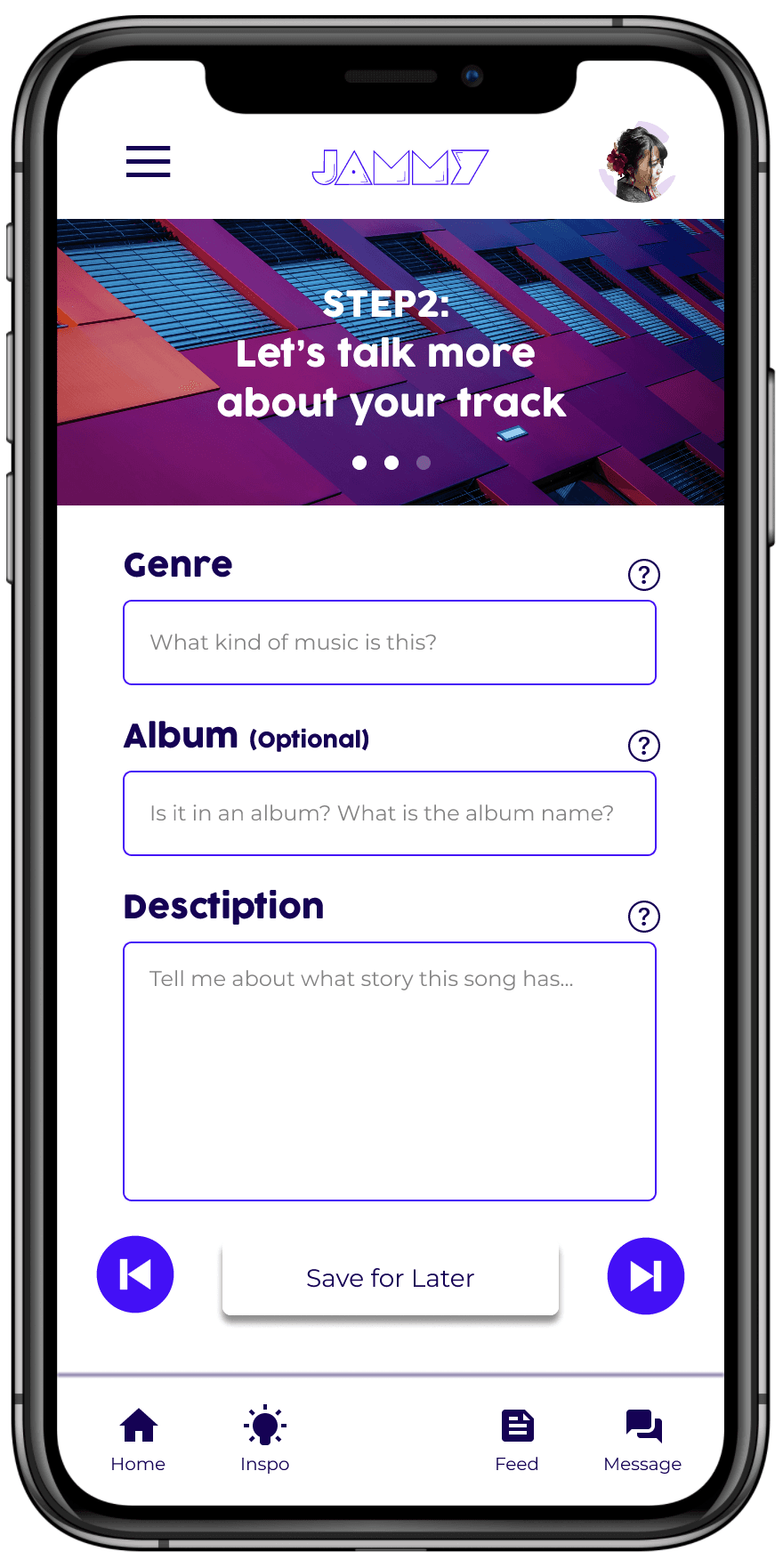
Problems to solve
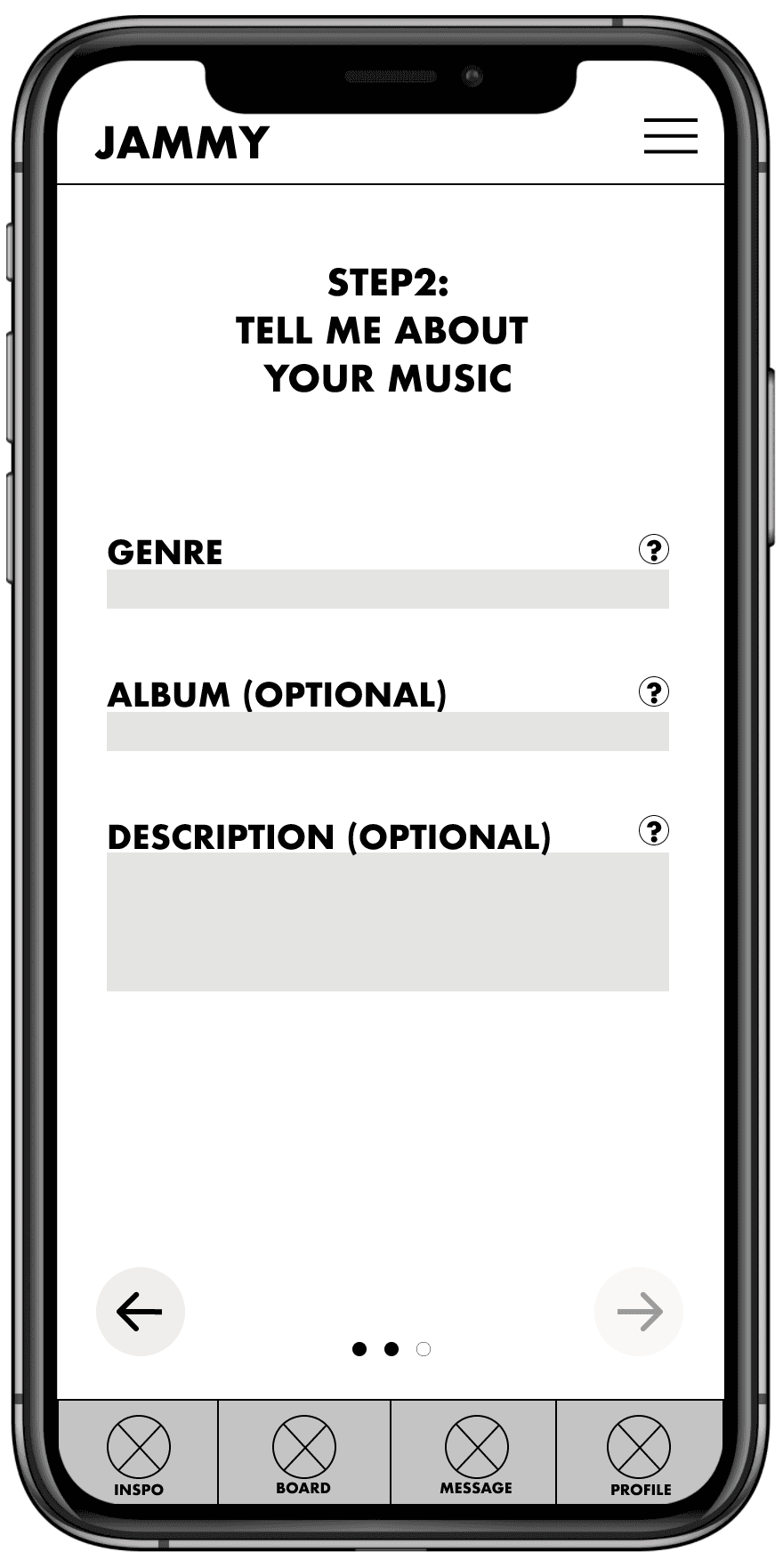
Users didn't know if "Album" field was required
No indication of what information was optional
How I fixed it
Added "(Optional)" labels to non-required fields
Included helper text: "Group your track with an album, or leave blank"
Optimized white space for cleaner visual hierarchy
Step 3
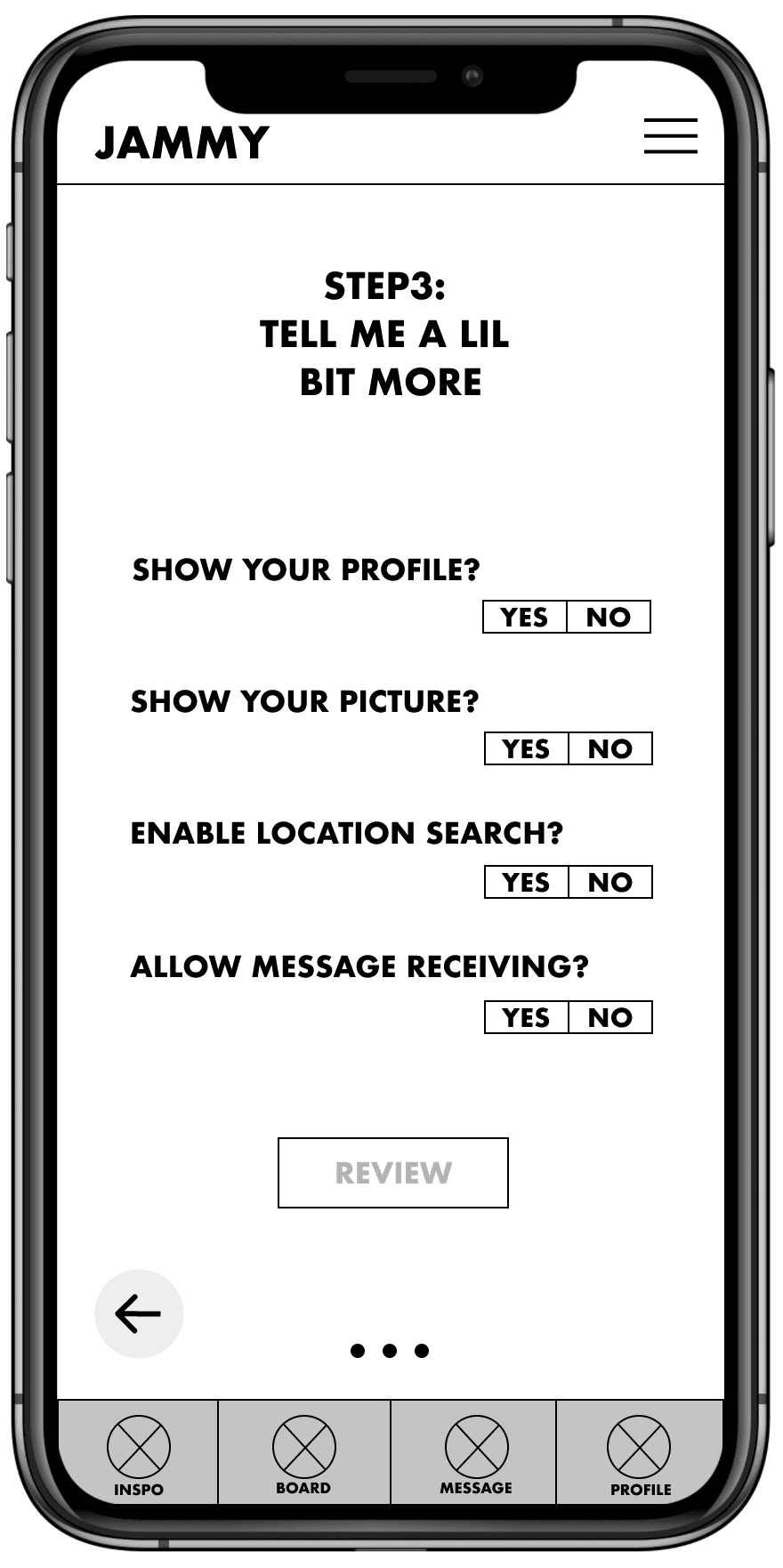
Problems to solve
Yes/No toggle was difficult to tap accurately
"Review" button was too small and easily missed
Layout felt cramped despite available screen space
How I fixed it
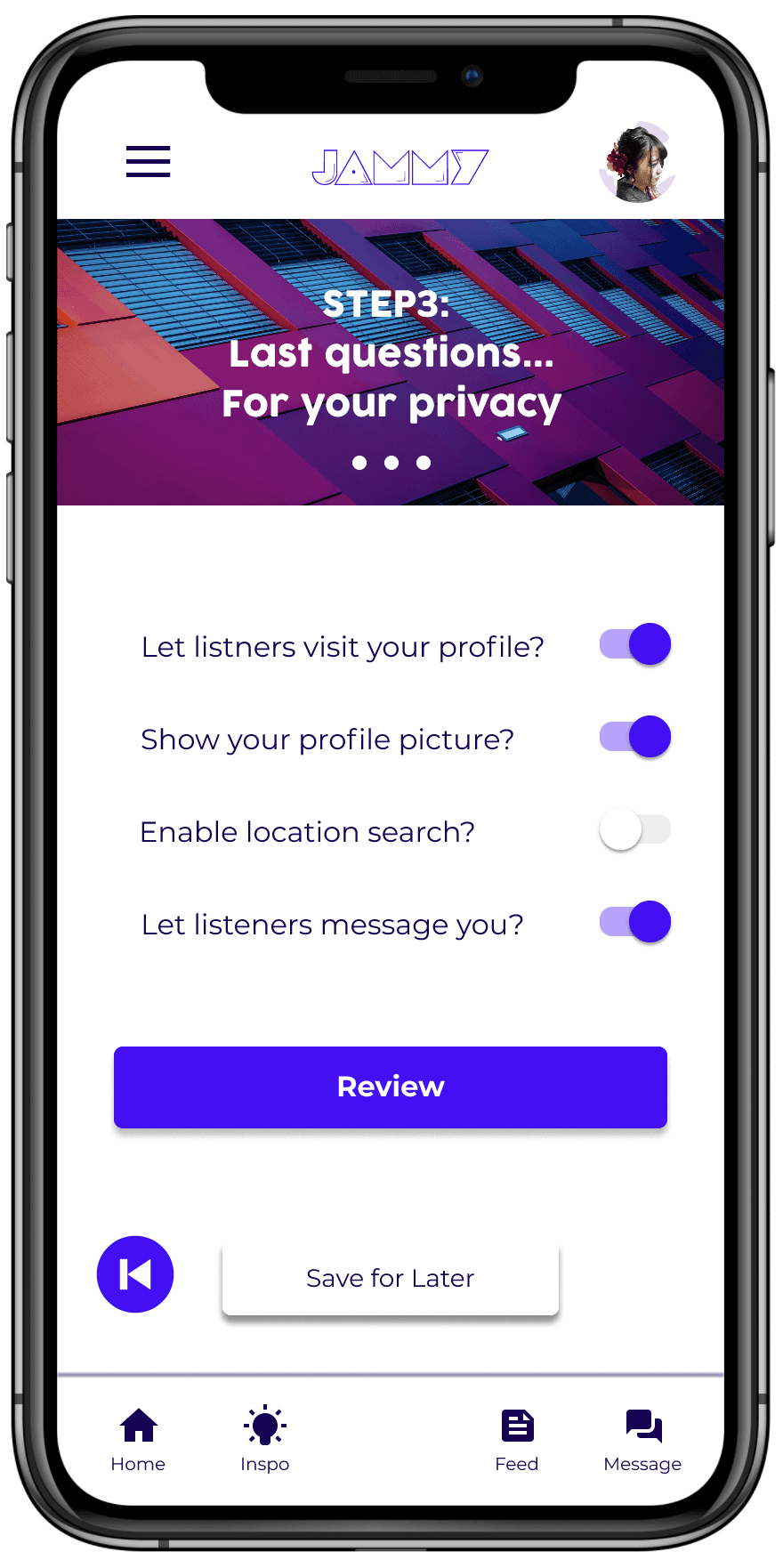
Replaced Yes/No buttons with iOS-style toggle switch
Increased "Review" button size by 60% and added accent color
Improved spacing between elements

Final Results:
Task completion rate increased from 60% (Round 1) to 95% (Round 2)
Average posting time dropped from 2min 45sec to 47 seconds
User satisfaction score: 4.3/5
All participants in Round 2 reported they would use Jammy regularly
✦ . ⁺ . ✦ . ⁺ . ✦
The Solution: Jammy
Core Experience
1. Post Your Track
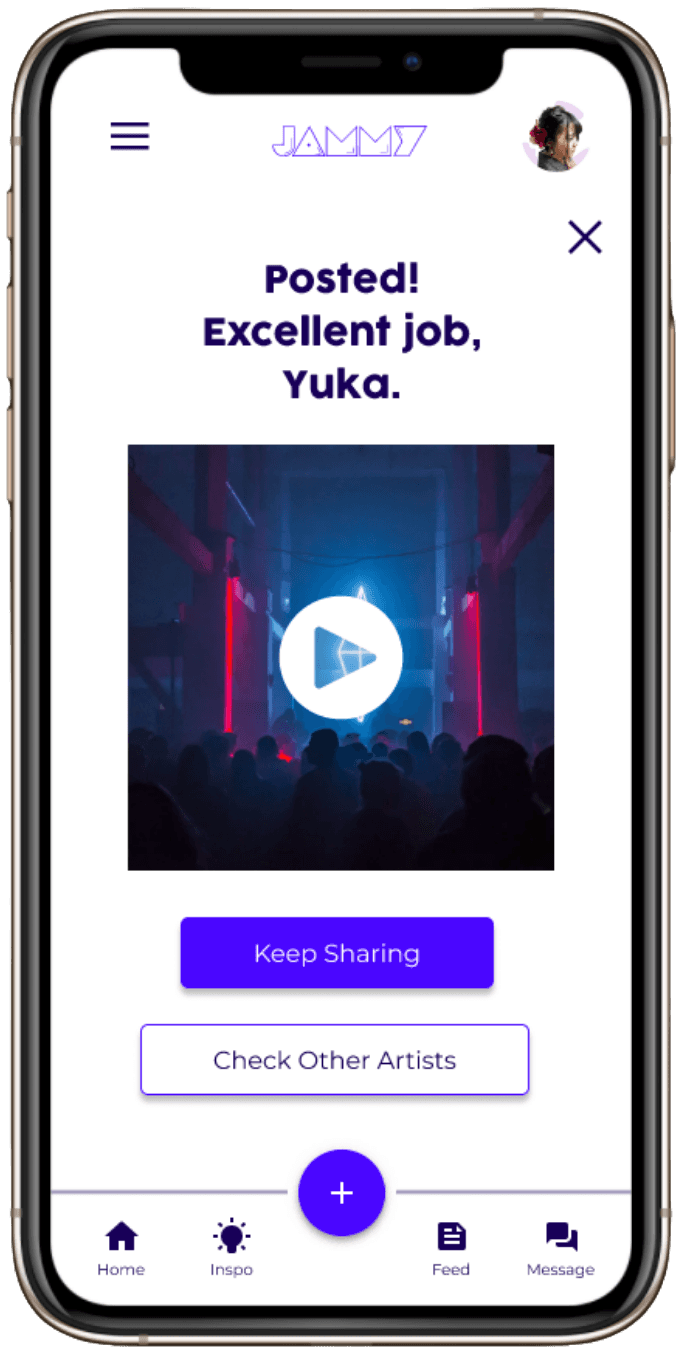
A 3-step flow that takes under 60 seconds. Upload your track, add a title and optional description, review, and publish. No metadata requirements, no overwhelming options.
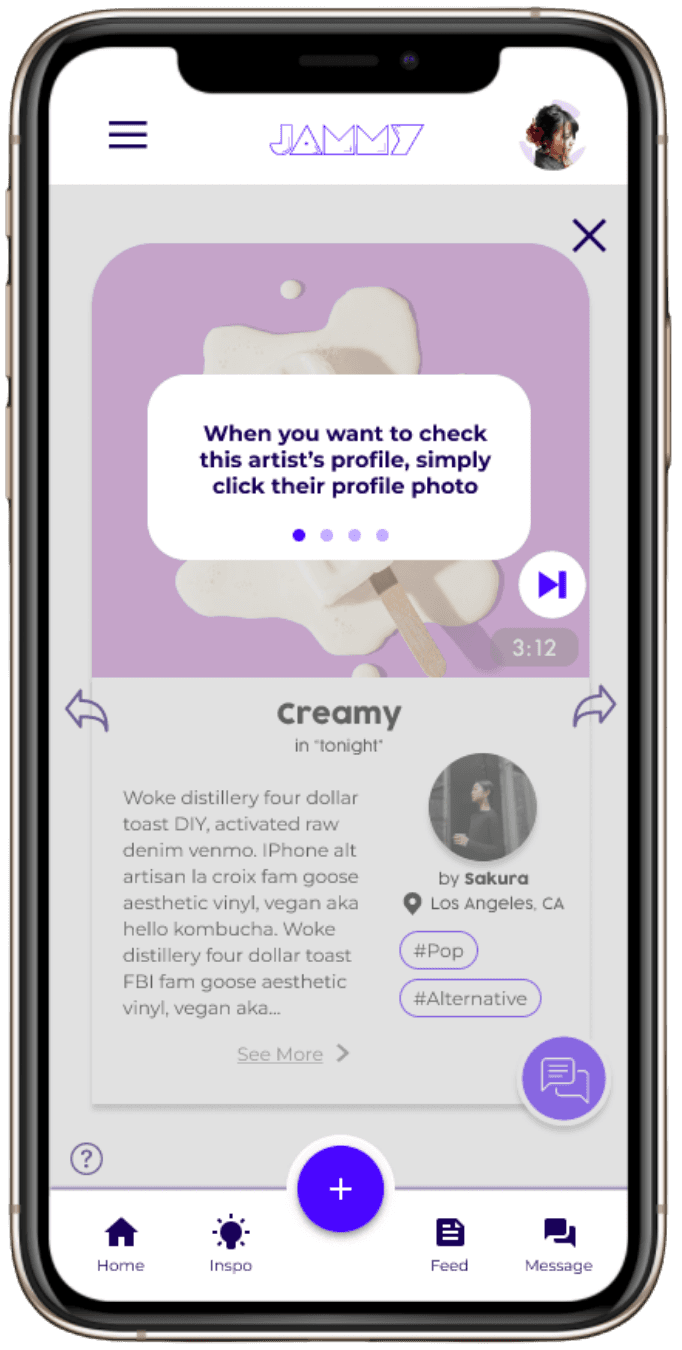
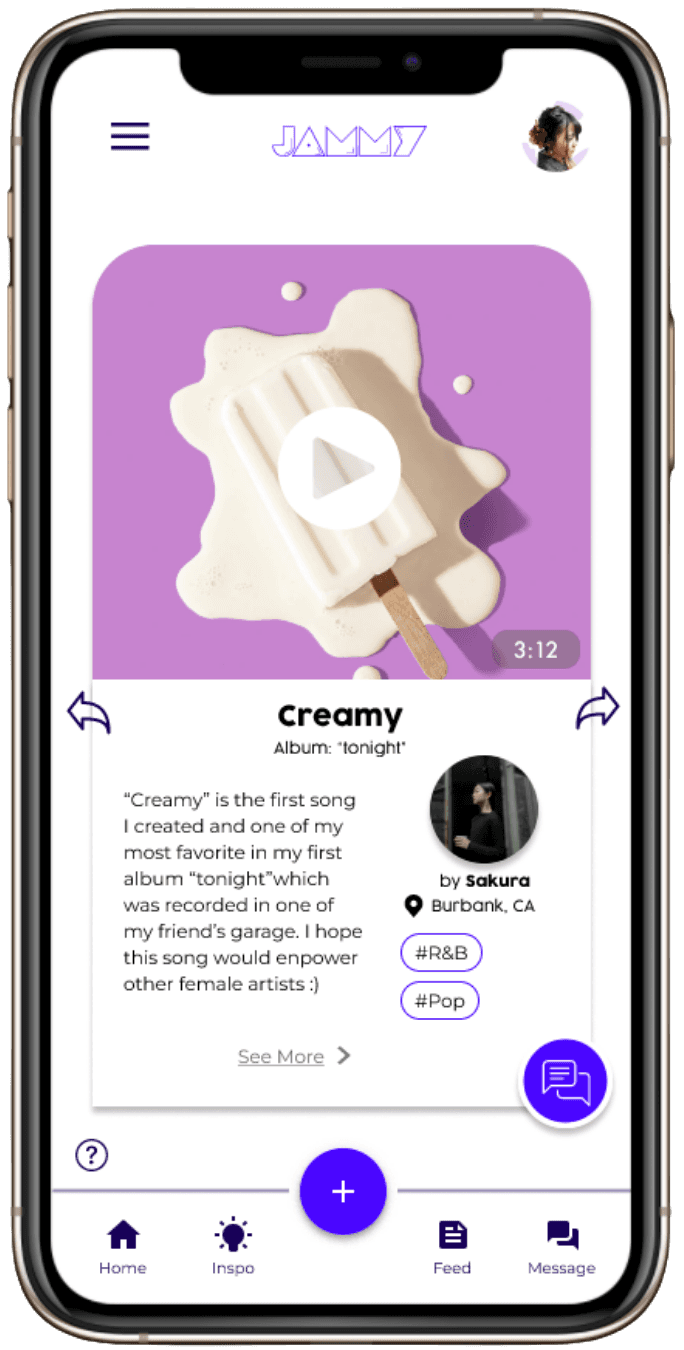
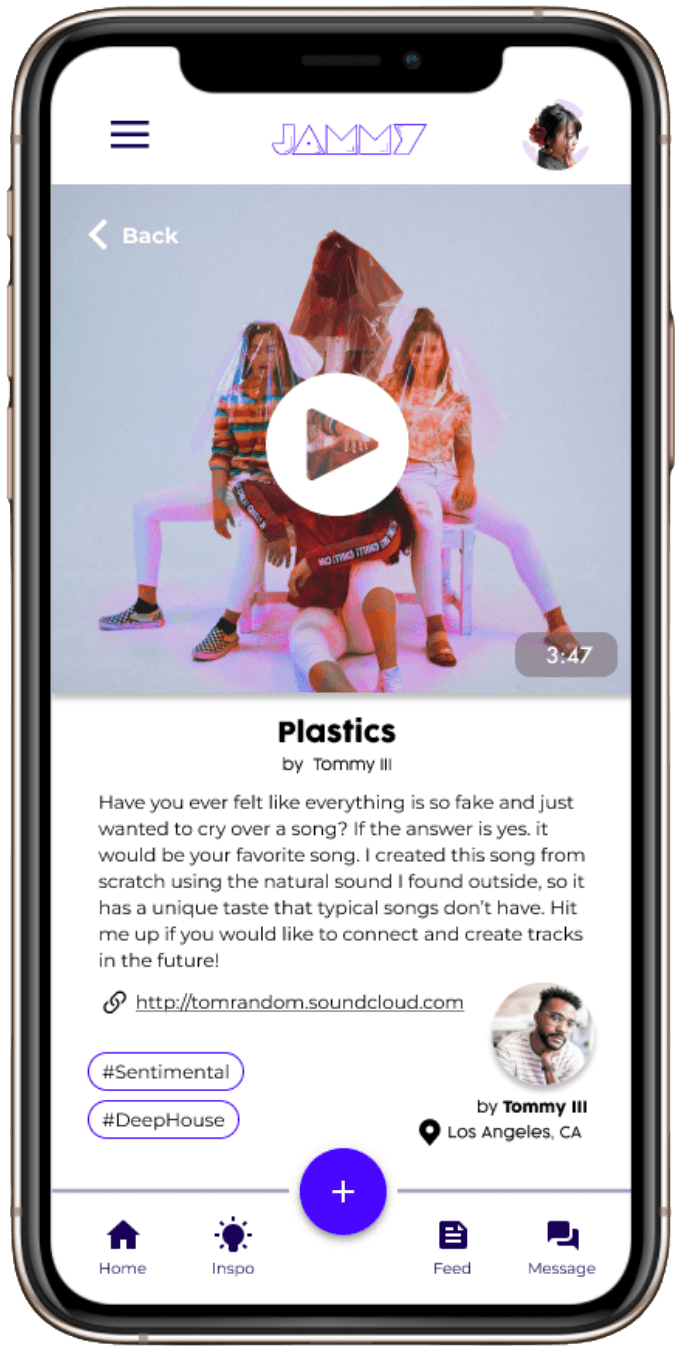
2. Discover Local Musicians
Location-filtered discovery (5, 10, or 25 miles) shows you musicians in your actual neighborhood. No algorithm pushing global stars—just the guitarist two blocks away or the producer in Silver Lake.

3. Build Community
Turn digital connections into real collaborations. Message musicians, comment on tracks, discover local gig opportunities. Geography becomes the feature, not just a filter.
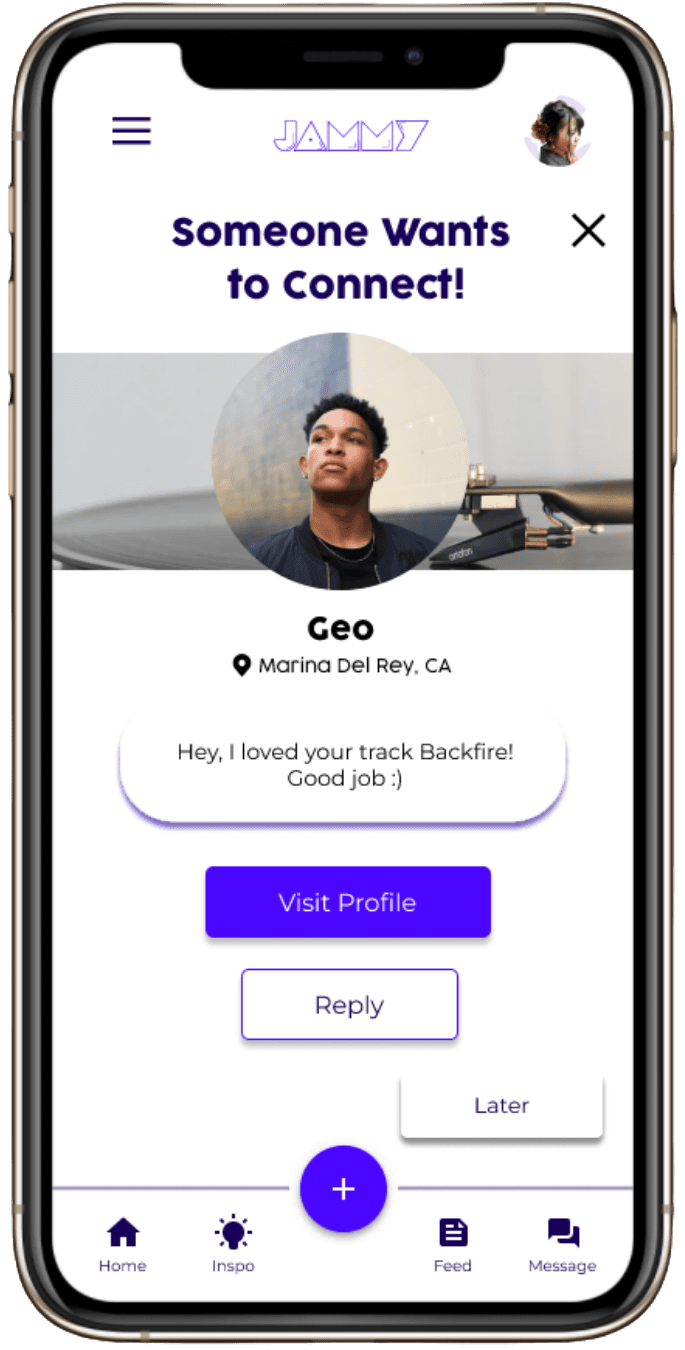
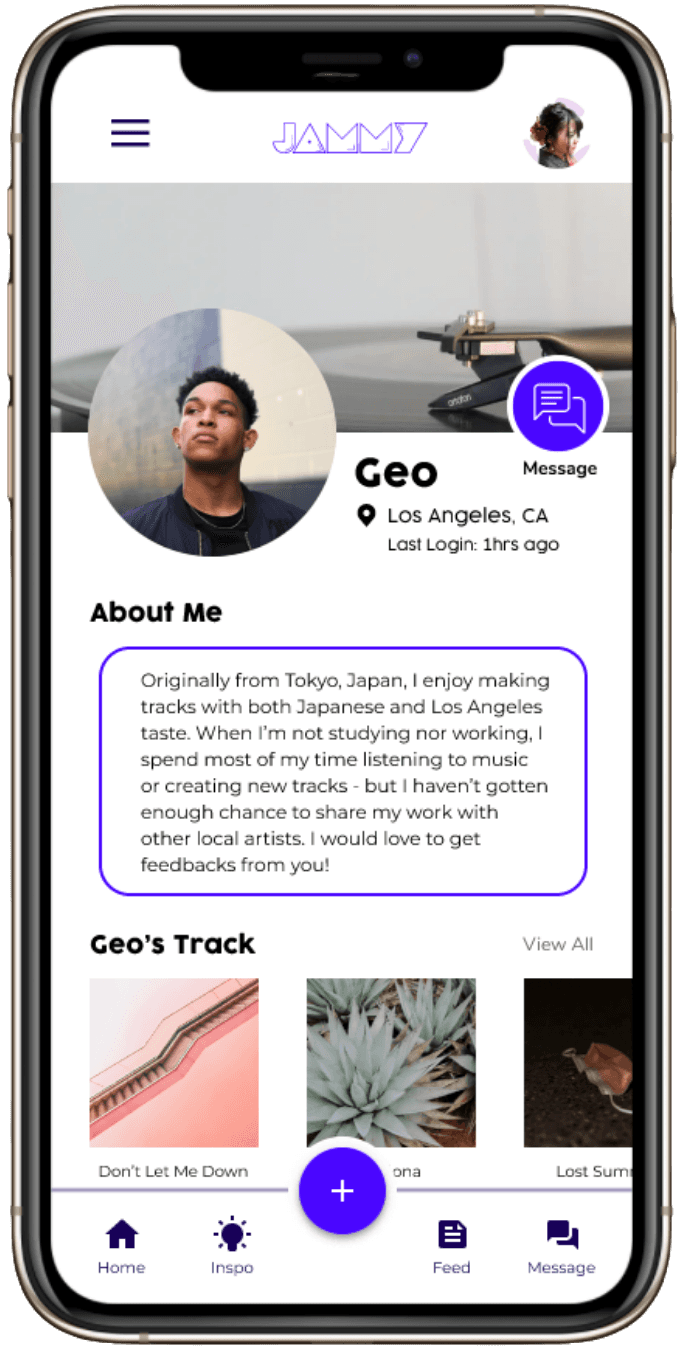
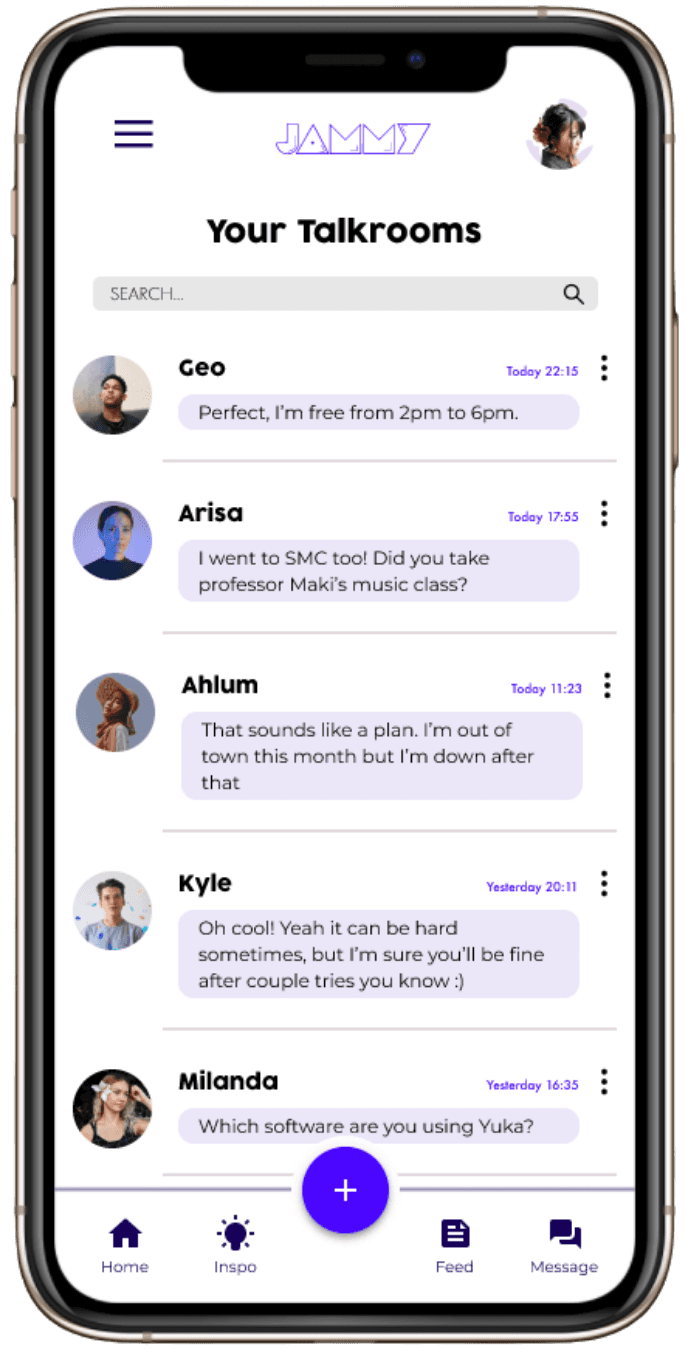
Key Features
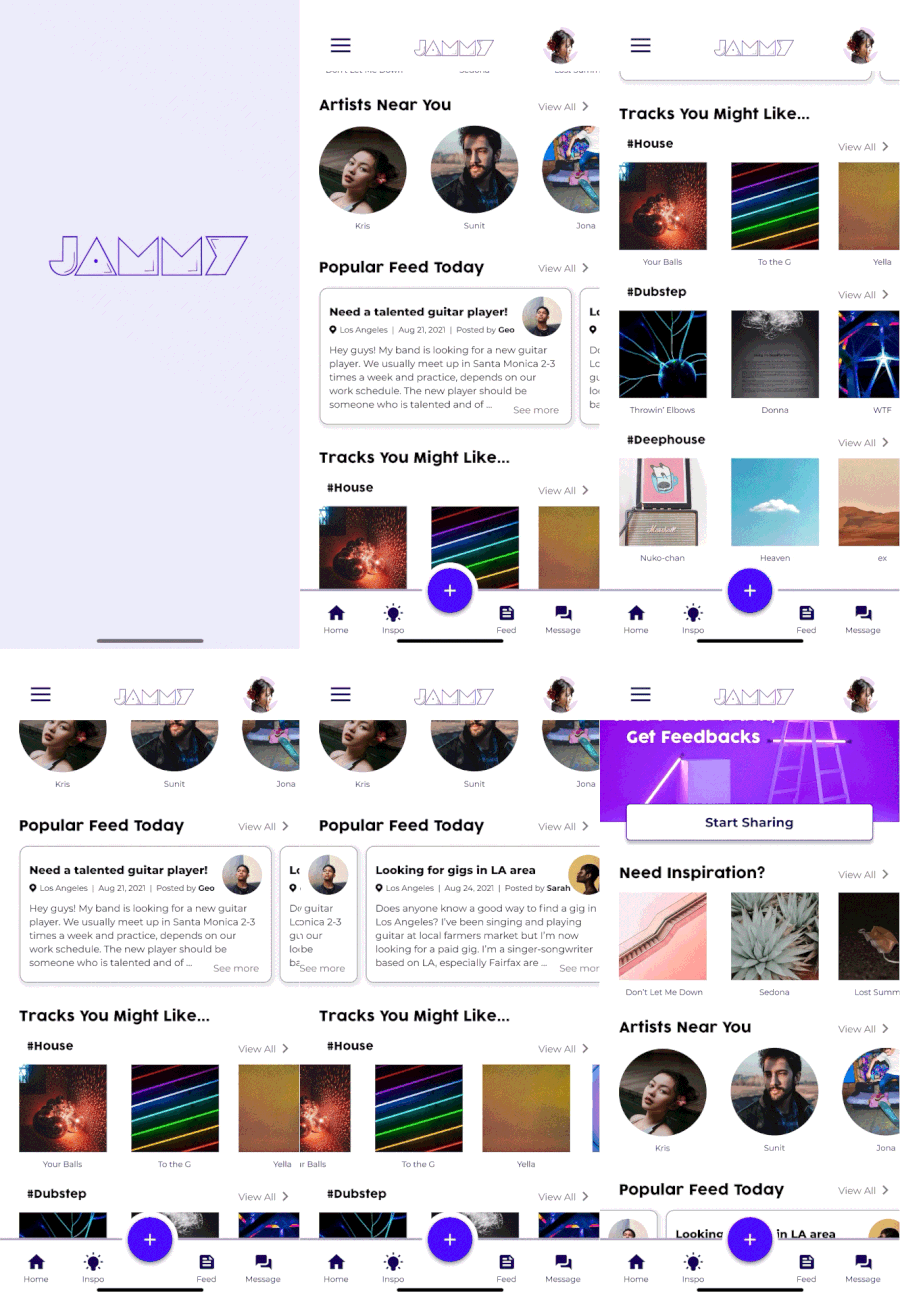
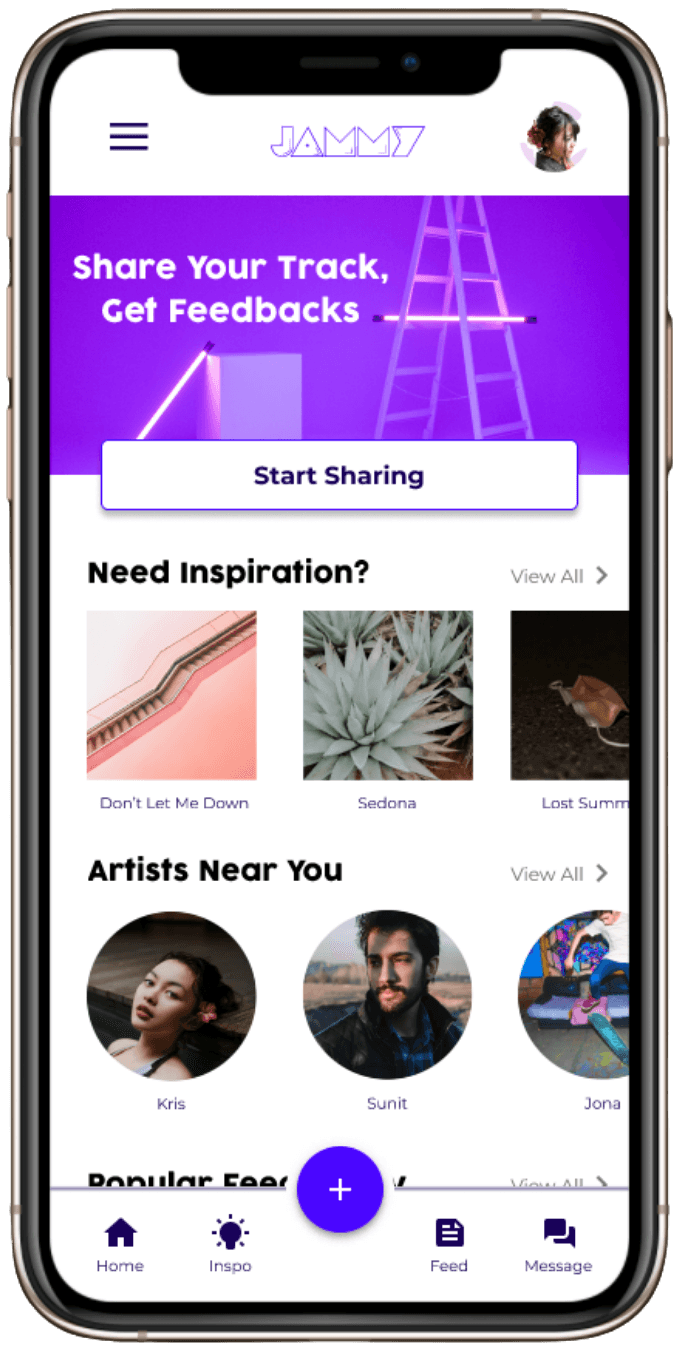
Home Screen: Your Creative Hub
Post tracks, explore local musicians' work, discover gig opportunities, and see activity from your network. All on one screen.

Swipe to Discover
Inspired by dating apps but for music discovery. Swipe right to save tracks, left to pass. Your tracks get discovered the same way—fast, visual, engaging.

Posting Made Simple
Upload → Title → Optional Details → Review → Publish. Every step is optional except the track itself. The interface remembers your preferences for next time.
Impact & Results
User Feedback:
"The sharing process is so clear and simple—I think I could actually share my work regularly now."
If deployed, success would be measured by:
Daily active posting rate (target: 40% of users post weekly)
User retention beyond first week (target: 60%)
Local connections made per user (target: 3+ within first month)
Time to first post (target: under 5 minutes from signup)
What's Next
Conduct larger-scale usability testing to validate all pain points are resolved
Explore integration with streaming platforms (Spotify, Apple Music) for seamless sharing
Research monetization models that don't compromise user experience
Investigate features like collaborative tracks and group jam sessions
✦ . ⁺ . ✦ . ⁺ . ✦
Reflection
Jammy was my first UX design project, and it taught me that constraints create clarity. When I limited myself to 'only three posting steps,' every decision became easier. What information is truly essential? What's just nice to have? The constraint forced honesty.
The initial posting flow had 8 steps. After testing, I cut it to 3. That single change transformed how users felt about sharing consistently.
What I learned about simplicity:
Every additional field in the posting flow dropped task completion by 15%. Ruthless simplification wasn't lazy design—it was strategic.
What I learned about local:
Users didn't want to compete with global stars on SoundCloud. They wanted to connect with the guitarist two blocks away. Geography became the feature, not a filter.
What I learned about testing early:
My initial button sizes were 36x36pt—below accessibility standards. I didn't notice until testing revealed users struggling to tap accurately. Numbers matter.
If this project succeeds, it won't be because the swipe interaction is fun (though it is). It'll be because a musician in Echo Park shared a track with someone in Silver Lake, and they met up to jam the next weekend.